
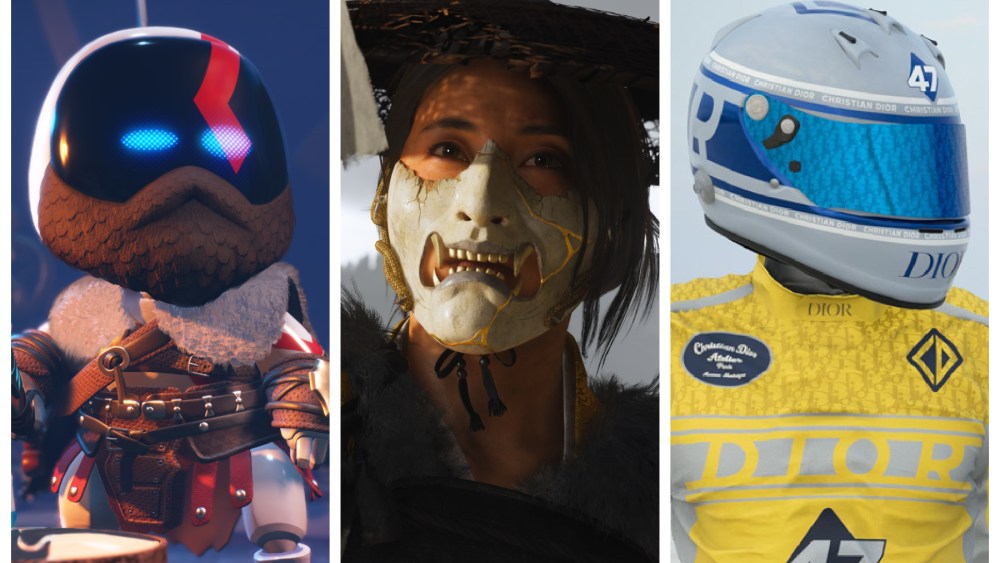
Five years ago, Sony’s PlayStation debuted its much-anticipated PlayStation 5 video game console amid the height of the COVID-19 pandemic in November 2020. This fall, as the gaming system celebrates its fifth anniversary, it comes on the heels of much success for one of its most prominent exclusive titles: Sucker Punch Productions’ “Ghost of Yōtei.”
A 2025 Game Awards nominee, “Yōtei” debuted in October as the follow-up to “Ghost of Tsushima.” While “Tsushima” was made for the PS4, the Sucker Punch team developed “Yōtei” for a whole new console and its DualSense controller.
“For the DualSense, it’s a great controller, and we definitely lean into that where we can. It’s a big team effort between the combat team, the audio team and the programming team to integrate that stuff,” Sucker Punch Productions director of programming Adrian Bentley told Variety. “We would lean into things, especially moments where we have critical gameplay. Combat is a big part of the game and giving you a feel for that, or even leaning into emotional moments. We do record haptic tracks to go with certain cutscenes to give you a stronger sense of what Atsu’s going through. And in terms of complexity, there is a lot of detail and tuning — the little games we create with painting the kanji or things like that — so they take some time, but it’s usually worth it to try and get a particular kind of feel in a particular scene.”
Sony
The group over at PlayStation’s Team Asobi, the developer behind 2024 Game of the Year winner “Astro Bot,” is also quite fond of the PS5’s DualSense and the haptic feedback aspects. In fact, much of their work on “Astro’s Playroom,” a pre-loaded game that came with the PS5 and introduced players to the device’s new features, helped shape what the DualSense controller team put into the final product.
“We would bring these controllers, which are like the future of games, concealed and wrapped up inside paper bags and carried from one building to the other,” Team Asobi studio head Nicolas Doucet said of working on the prototype project at PlayStation’s offices in Japan. “Which is great because it makes you feel like there is still very much a human story behind it, where people get together and just try things and then something good comes out of it.”
While Doucet can’t confirm if there will be an “Astro Bot 2,” he did say that the learnings from “Astro’s Playroom” that led to the first “Astro Bot” game are a good indicator of what ideas are still leftover after working on “Astro Bot” that could go into future games.
“‘Astro’s Playroom’ gave us a great springboard to go to ‘Astro Bot’ because a lot of things that we tested during the DualSense exploration into ‘Astro’s Playroom’ could not be fitted into the pre-loaded game,” Doucet said. “First, we had to make our list of, what are the things that we really want people to feel that are the most immediate. And we had this really, really cool demo of a chainsaw, actually, where you could cut wood and it was classic, real-world expressions. And we felt like, OK, it’s not really our content — we want it to be super friendly. But during ‘Astro Bot,’ as we were making the game and developing this richer story with rebuilding the mothership, we thought, Oh, hold on, maybe all of these DIY interactions that worked really well with the DualSense, that’s a way to bring them back. And if we can add a sci-fi touch to them, we’ll get away from them feeling maybe too real and a little bit too daunting.”

Sony
Doucet added: “What I’m saying is, as we do this kind of cycle of research, and then making a game, and then research making games, there is always something in the past that we’ve made that maybe didn’t fit back in those days, for various reasons, that later we can go back to and with a new pair of eyes or updated learning or updated knowledge, and revisit and maybe twist and find a new usage for.”
The PS5 turns five on the heels of PlayStation celebrating its 30th anniversary. And some studios developing for the latest console have been there from the beginning, including the minds behind “Gran Turismo.”
“PlayStation can be divided into a few different generations,” said Kazunori Yamauchi, head of PlayStation’s “Gran Turismo” studio, Polyphony Digital. “The PS1 and 2 were one generation. PS3 was another generation. And then PlayStation 4 and 5 are also a similar generation from one another. And from the PS4 and beyond, it has become easier to make video games, and it also provides really high performance. So when I first heard the plans for the PS5, I had pretty high expectations.”
Yamauchi and the Polyphony Digital team’s highest expectation, as a studio focused on the racing game genre, was what the PS5’s ray tracing capabilities would be.
“For racing games, of course, the immersiveness and the atmosphere is very important to convey to our users,” Yamauchi said. “And of course, the internal calculations and the simulation is important — but it’s really important how to convey that to our users. Then that involves the display, the sound, the haptics and the touch. But the thing that we really wanted to achieve on the PS5 with ‘GT7’ was really the ray tracing.”
Yamauchi says ray tracing technology was already being researched when the first “Gran Turismo” game was created for the first PlayStation console in 1997.
“But back then, it was being developed on a huge supercomputer, and they were doing real-time ray tracing, but it was something along the lines of four frames per second or something like that,” Yamauchi said. “But with a PS5 video game console, we’re now able to do ray tracing at a high frame rate — and that was pretty revolutionary for us, because when we were making ‘Gran Turismo 1,’ it was a sort of a dream for us to one day be able to do the ray tracing like this.”
While there is still no official announcement on what the next step will be for Sony’s PlayStation in the console business, beyond the PS5 and PS5 Pro, the developers that work most directly with the product say they aren’t in a rush to jump to the next offering.
“I don’t know, I think PS5 is pretty good!” “Yōtei” developer Bentley said, adding there are a few wishlist items for future projects: “So a lot of it is just more of the same: ray tracing is a fun technology that’s still growing, and there’s lots of other graphics card technologies out there you could see. For us, a lot of it is whatever helps us make games efficiently. That’s one of the big things that we that we like and a lot of that is in software more than hardware. But continuing to allow us to scale up our ambitions for games is definitely a fun thing to participate in.”