Right around 2007, when Call of Duty 4: Modern Warfare took over the gaming world, FPS games stopped being as creative as they once were and started trying to mimic the new king of the genre. It’s hard to blame them; COD4 is an absolute masterpiece, and trying emulate its success is a no-brainer. However, it does mean that the genre began to stagnate.
Thankfully, while these next FPS games have been largely forgotten, they did not try to copycat what was popular at the time. Some came before COD4, and most came after, but while they didn’t catch on in the same way, they all refused to play it safe, experimenting with new mechanics and ideas, and producing a lot of phenomenal and creative gameplay as a result.
Rearrange the covers into the correct US release order.

Rearrange the covers into the correct US release order.
Easy (5)Medium (7)Hard (10)
Prey (2006)
Portals Before Portal
Before the 2017 immersive sim with the same name, Prey (2006) was a wildly creative FPS that took some ideas from Halo, some from Half-Life 2, and tried to create an alien spaceship setting that felt truly alien. Sure enough, that’s exactly what happened. From the weapons to the wild traversal ideas, Pray (2006) was experimenting left and right.
For one, Prey had portals that look and function exactly like the ones in Portal, but it was released one year earlier (granted, you don’t get a Portal Gun, but still). Then there are the walkways that invert gravity for both you and enemies. It also stars an Indigenous protagonist, something that was virtually unheard of back in 2006, especially for a sci-fi game. While the cancelation of Prey 2 still hurts, the first game is a great time and worth it to pick up and play all these years later.
Gotham City Impostors
DC Comics Running In Its Veins

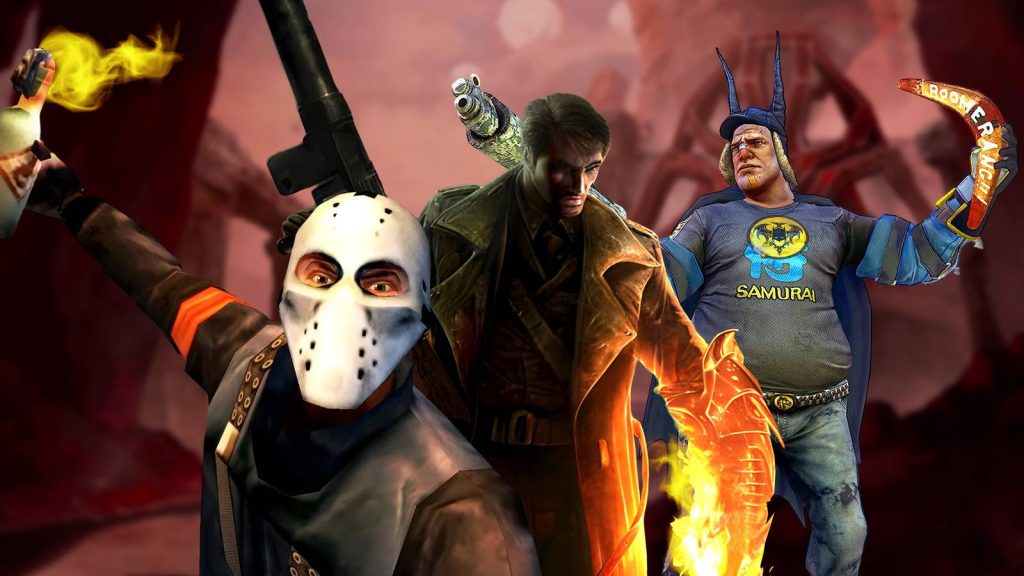
I’m still surprised at how quietly Gotham City Impostors came and went. Sure, it’s a Batman game that doesn’t prominently feature any of Batman’s iconic characters, but it’s also an incredibly unique multiplayer FPS that grounds every single mechanic in the weird world of Gotham City, starring fanboys of Batman and The Joker who battle it out in the streets.
Each class’ standard weapons might be generic, but their special abilities are anything but, like a glider that lets you dive-bomb opponents from above, or rollerblades that let you zip around the map and launch off of ramps. Similarly, the unlockable special weapons are all weird and perfectly suited to the game’s world, like a boomerang that stuns your target, or an explosive slingshot. Even though it has been delisted from storefronts, the Gotham City Impostors servers are still running, so if you can get your hands on a copy somehow, you can still jump into the fray.
Singularity
The Time-Travel Shooter That Never Caught On
First-person shooters with time-travel mechanics are often beloved by the gaming community, or at least become cult classics. Look no further than TimeSplitters or that one iconic level from Titanfall 2. Yet, for whatever reason, Singularity never received the same love, even though it has arguably the most robust time manipulation mechanics of the bunch.
From slowing time like Point Man in F.E.A.R. to rebuilding and altering the environment to create cover to throwing and pulling objects like Half-Life 2’s Gravity Gun , Singularity had a lot of cool ideas on display, some borrowed from other iconic FPS games and some entirely its own. It had a pretty interesting alt-history story running in the background, too. Singularity, and Raven Software as a studio (before it became a Call of Duty factory) weren’t afraid to be weird, and that’s what made them both so memorable.
NecroVisioN
Like First-Person Wolverine

NecroVisioN is one of those games that starts out pretty unremarkable before one level right in the middle changes everything and turns the back half of the campaign into something wildly original. Set during World War 1, you shoot your way through bunkers and strongholds, killing enemy soldiers, but also demons and vampires. Then, after you kill a particularly strong vampire, you unlock a glaive called the Shadow Hand, which unlocks the game’s brilliance.
After you get the Shadow Hand, you’re sent to the vampire world and can use the blades that emerge from your new glaive to carve up demons like they’re butter. It’s awesome, and it gets even better because, as you dispatch more enemies, you unlock new powers, like an exploding fireball or a freeze spell. Is there a narrative reason for all of this? Oh yeah, but that’s really not the draw here. Playing as first-person, demon-killing Wolverine is, and it feels great. NecroVisioN might have slow pacing to start, but by the halfway point, things are moving at a breakneck pace, and they never let up until the credits roll.
Urban Chaos: Riot Response
Action Cops Save The City
Developed by a little British studio called Rocksteady before it moved on to making Batman games, Urban Chaos: Riot Response is an FPS where you play as a police officer sent in to absolutely decimate any gang members who step in your path. It is way more action oriented than a game about the police maybe should be, but boy is it ever a fun time.
The biggest difference between Urban Chaos: Riot Response and other FPS games of the era is the inclusion of a riot shield, which is kind of the game’s main mechanic. You can pull this shield up at any time and absorb most kinds of damage, from machine gun fire to Molotov cocktails. Then there are the hilarious slow-motion hostage “negotiations,” in which you need to shoot the hostage taker and occasionally launch them into a wall of explosive barrels. The game has a massive arsenal of weapons, all of which you carry with you at all times (because that’s what cops do). It’s just a fun little gem that doesn’t take itself too seriously, and tries to put its own spin on the FPS genre, largely to great effect.
F.E.A.R. 3
Saves The Best For Co-Op

The first F.E.A.R. is still a beloved action horror FPS, while the sequel, F.E.A.R. 2: Project Origin, is well-liked (especially its ending) but considered a step down from the first game. F.E.A.R. 3 is almost entirely forgotten though, releasing after the series had lost most of its momentum and struggling to give players a reason to jump back in. The biggest issue was that F.E.A.R. 3 reserved its best and most innovative ideas for player 2 in a co-op campaign.
Just like in the first two games, you play as Point Man in F.E.A.R. 3’s single-player campaign, with his patented Slow-Mo ability that lets him slow down time and blast multiple enemies in quick succession, resulting in endlessly satisfying explosions of gore. However, player 2 plays as Paxton Fettel, the antagonist from the first game. Fettel has a slew of psychic abilities that make him a completely unique gameplay experience. He can possess enemies, make them shoot their allies, and the make the possessed’s body explode. He can telekinetically pick up enemies and objects and hurl them around the battlefield, or summon a massive wave of energy to kill multiple enemies at once. Fettel’s gameplay is by far the best part of F.E.A.R. 3, but unless you had a co-op friend to play with, you likely never experienced it.
What If the Doom Slayer Could Also Hear DOOM’s Music?

Metal: Hellsinger definitely had its time in the sun, but it seems to have largely vanished from the gaming conversation. Its inspirations are clear as day, and they boil down to one franchise: DOOM, especially the modern reboot games. However, rather than just being another boomer shooter with an awesome soundtrack and a ton of fast-paced violence, Metal: Hellsinger incorporates its soundtrack into gameplay in a very inspired way.
While you can just go in and start blasting away, shooting enemies to the beat of the music will deal more damage. However, it will also increase the music’s intensity, making it harder to maintain a steady combo of shooting on the beat. Playing Metal: Hellsinger kind of feels like rewiring your brain at first, because you have to keep from thinking of the music as a background element, but once you get the hang of it, it’s a cathartic experience. The phenomenal metal soundtrack—featuring work by Serj Tankian from System of a Down and Randy Blythe from Lamb of God, among others—fuzes completely with the gameplay, creating an experience that intertwines your senses into a ballet of violence and gunfire.